
Board0Book a consultation
Amattra
Book a consultation
+91 999 985 2115
contact@amattraexports.com

The technique atlas

Eight hand embroidery techniques, worked by hand.

What each technique is, how it is made and where it sits best on a garment. Hover over or tap a swatch to look closer.

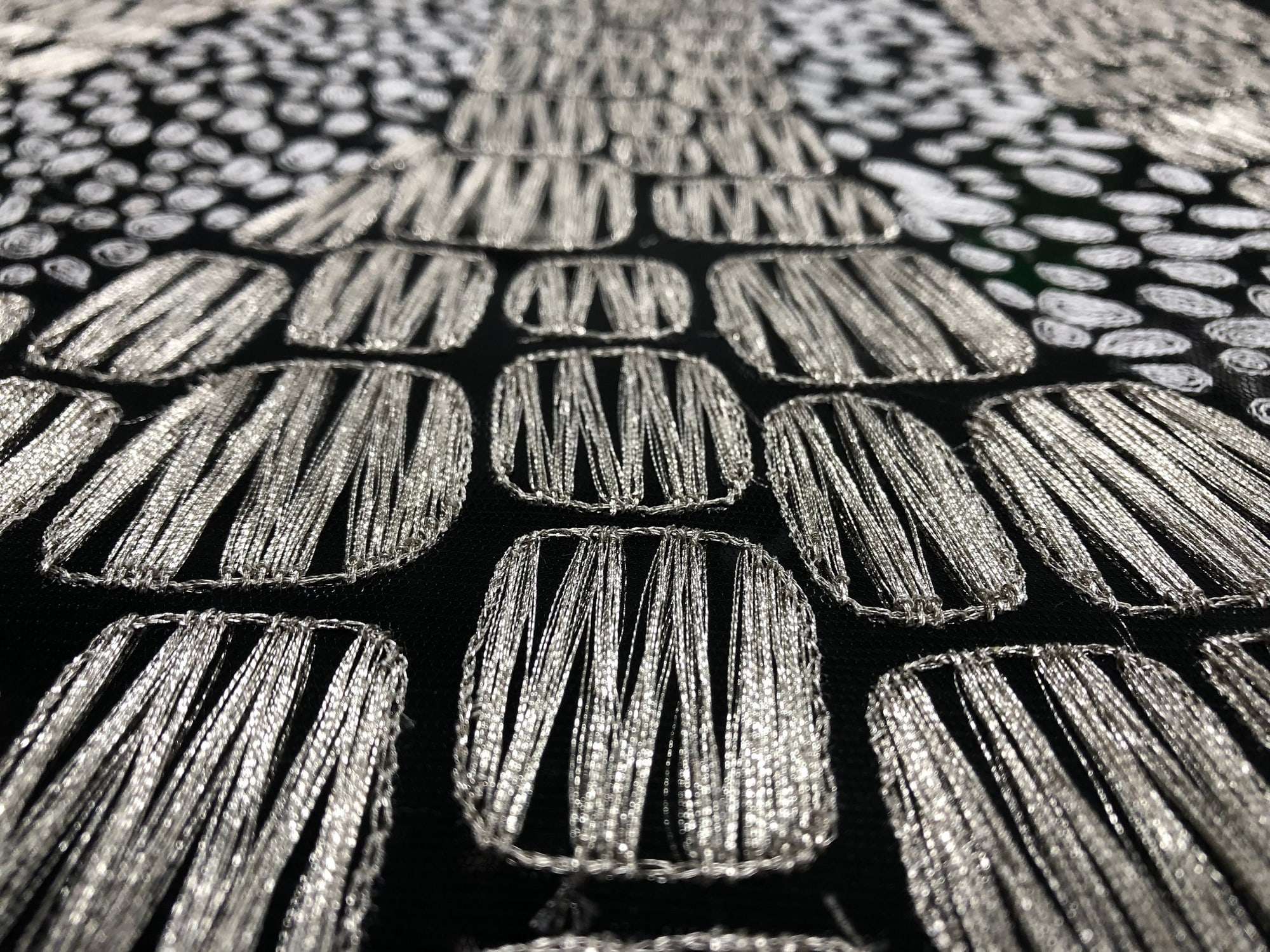
Rows of silver metal-thread shapes worked on black fabric
Plate 01Zardozi

Zardozi

Couched metal thread and cut wire, in relief.

What it is
Zardozi is hand embroidery in metal: metallic thread couched on the surface, and coiled wire cut and stitched like beads, worked on a stretched frame and often finished with sequins and stones. It gives weight and relief to structured pieces.
How it is made
The fabric is stretched tight on a wooden frame. Working from above with a fine needle, the artisan lays metallic thread on the surface and couches it down with small stitches, and threads short cut lengths of coiled wire like beads, padding and layering to build relief.
Where it suits
Placed motifs on bodices, collars, cuffs and borders, where weight is an advantage. It asks for a fabric with enough body to carry it. Best on: bridal, evening wear, accessories and jewellery.
Materials
  • Metallic thread
  • Cut coiled wire
  • Sequins and stones
An artisan placing fine embroidery along a tulle panel by hand
Plate 02Aari

Aari

Fine hooked chain stitch.

What it is
Aari is a fine chain stitch worked on a frame with a hooked needle. It suits flowing lines, dense fills and delicate outlines on silk, tulle and heavier cloth alike. European ateliers know it as tambour or Lunéville work.
How it is made
With the cloth on the frame, the artisan holds the thread underneath and a fine hook above. Each pass of the hook pulls a loop through the fabric to form a chain stitch, and beads or sequins can be caught along the same drawn line.
Where it suits
Flowing linework, vines and fine fills on tulle, organza and silk. It follows a curve easily, so it works well across a whole panel. Best on: bridal, ready-to-wear, kaftans and resort, kids occasion wear.
Materials
  • Silk and cotton thread
  • Metallic thread
  • Small beads and sequins
Fern leaves in white and silver beads and sequins on black fabric
Plate 03Hand beading

Hand beading

Glass, crystal and pearl, placed by hand.

What it is
Hand beading is the placing of glass, crystal, bugle and pearl beads by hand, from scattered constellations to fully covered surfaces.
How it is made
Each bead is picked up on the needle and stitched down, singly or a few at a time, following the chalked artwork. Size, direction and density are varied to shade a motif from scattered to solid.
Where it suits
Bodices, sleeves and necklines, allover evening surfaces and jewellery pieces. Scatter it for lightness or fill it for weight. Best on: evening wear, bridal, accessories and jewellery, ready-to-wear.
Materials
  • Glass seed beads
  • Bugle beads
  • Crystals and pearls
Black sequin leaf with gold bead fronds embroidered on black fabric
Plate 04Sequin work

Sequin work

Light that moves with the wearer.

What it is
Sequin work is embroidery in sequins and paillettes, laid in tonal or contrasting layers, single or strung, to build movement and depth across a panel.
How it is made
Sequins are stitched flat and overlapped in rows so each one hides the stitch of the last, or stacked and angled so they stand and catch the light. Matte and shiny finishes are mixed for depth.
Where it suits
Allover panels that need movement, and graphic placements where a shape should read from across a room. Best on: evening wear, ready-to-wear, kids occasion wear, kaftans and resort.
Materials
  • Flat and cup sequins
  • Paillettes
  • Bugle beads for veins
Spools of coloured thread and a shade card beside a lettering sample stitched on woven fabric
Plate 05Threadwork

Threadwork

Colour and texture in silk and cotton.

What it is
Threadwork is embroidery in satin stitch, stem stitch and knots, in silk, cotton or metallic thread. It is the most painterly of the techniques, and the easiest to colour-match.
How it is made
The artwork is transferred to the cloth, then filled and outlined in stitch: satin stitch for smooth fills, stem stitch for lines, knots for texture. Shades are chosen against a thread card before work begins.
Where it suits
Lighter garments and everyday wear, where the surface should stay soft to the touch. Colour does the work here. Best on: ready-to-wear, kaftans and resort, kids occasion wear, evening wear.
Materials
  • Silk thread
  • Cotton thread
  • Metallic thread
Hands arranging white appliqué leaf shapes on navy fabric
Plate 06Cutwork and appliqué

Cutwork and appliqué

Shapes stitched on, and cloth cut away.

What it is
Cutwork and appliqué is a pair of techniques. Appliqué stitches cut shapes of fabric, organza or tulle onto the base. Cutwork outlines a motif in close stitching, then cuts the cloth away inside it.
How it is made
For appliqué, shapes are cut from fabric, placed on the base cloth and stitched down around the edge. For cutwork, the outline of the motif is closely stitched first, then the cloth inside it is cut away, so the edge does not fray.
Where it suits
Sheer overlays, yokes, sleeves and hems, and anywhere a motif needs scale without weight. Best on: bridal, ready-to-wear, kaftans and resort, evening wear.
Materials
  • Organza and tulle
  • Fabric motifs
  • Edging thread
Macro view of a branch motif made from beads, crystals and metallic pieces on black fabric
Plate 07Mirror work

Mirror work

Small mirrors, held in thread.

What it is
Mirror work is embroidery that secures small mirrors and reflective pieces in stitched frames of thread, giving a graphic, light-catching surface.
How it is made
Each mirror is laid on the fabric and held by a lattice of foundation stitches, then covered with a ring of close stitching that frames it and locks it in place.
Where it suits
Borders, yokes and scattered placements on resort and ready-to-wear pieces, and small accessories. Best on: kaftans and resort, ready-to-wear, kids occasion wear, accessories and jewellery.
Materials
  • Small mirrors
  • Reflective pieces
  • Cotton or silk thread
White chiffon petals gathered with pearls and crystals
Plate 083D floral ornamentation

3D floral ornamentation

Flowers that stand off the fabric.

What it is
3D floral ornamentation is the building of petals and blooms from organza, chiffon, pearls and beads, shaped by hand so they lift away from the cloth.
How it is made
Petals are cut from sheer fabrics and shaped by folding, gathering or rolling the edge. Each is anchored at its base so the rest stands free, and beads, pearls or crystals finish the centre.
Where it suits
Shoulders, necklines, collars and veils, and scattered across tulle skirts where the flowers can move. Best on: bridal, evening wear, accessories and jewellery.
Materials
  • Organza and chiffon
  • Pearls
  • Beads and crystals

Find your technique

Tell us the garment. We suggest where to begin.

Not sure which craft suits the piece? Two choices give you a shortlist to bring to your consultation.

01What are you making?
02What should it feel like?

Pick one or both. We match them to the crafts our artisans work in.

Your shortlist appears here.Choose a garment and an effect on the left, and we suggest the techniques to start from.
Six embroidered swatches in white, cream and brown shown together

Plate 09Reference swatch library

Reference swatch library

A library to design from.

Working through the year, our creatives build a wide range of embellished swatches that design teams refer to while developing a collection. Our international clients work with our in-house designers on collections season after season.

Ask for the swatches closest to your idea, or send a reference and we develop it.


Talk to our studio

Found a technique you like?

Tell us the garment and the effect you want, and we sample it to your brief.